
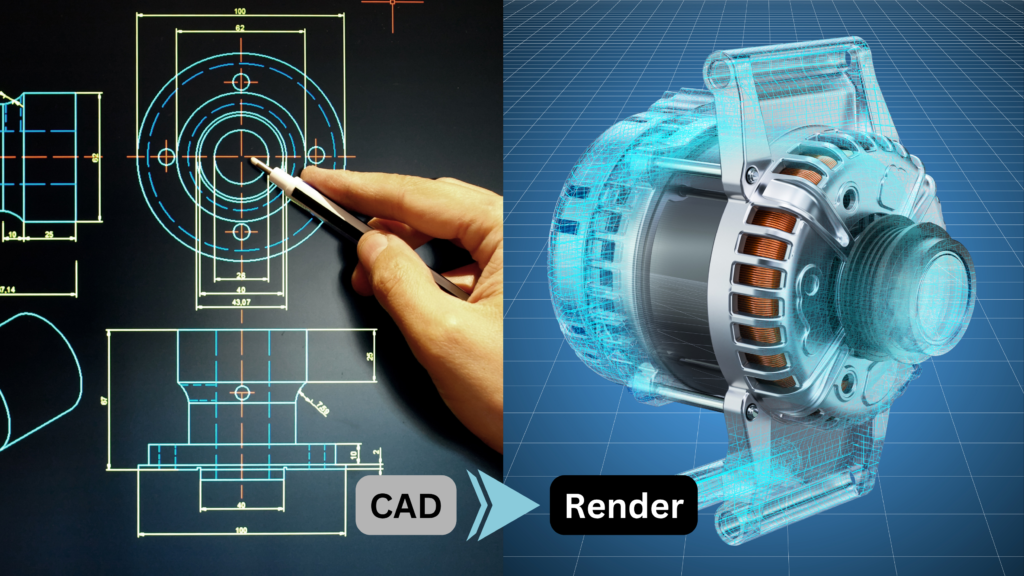
You have spent months — sometimes years — engineering a product. Every dimension is precise. Every mechanism is tested. Your CAD model is a masterpiece of engineering detail. And then you need to show it to a client, a distributor, or a trade show audience, and you hand them a flat PDF with a line drawing. That gap between what your product is and how it gets communicated to the world is exactly what 3D visualization solves.
This guide walks you through how Indian manufacturers are converting their CAD files into photorealistic 3D visualizations, exploded view animations and interactive machine demos — step by step. Whether you are exploring this process for the first time or evaluating a vendor, this is the clearest and most practical explanation you will find.
Picture two new hires on their first day at a machinery manufacturing company. One sits through a 200-page PDF manual and a slideshow about how the equipment works. The other puts on a headset, walks through a fully interactive 3D model of the same machine, taps on parts to see them explode into view, and runs a virtual fault diagnosis before lunch.
Three weeks later, only one of them is operating independently on the shop floor — and it’s not the one with the PDF.
This is the gap that 3D gamification of machine training is closing across manufacturing, industrial equipment, and engineering companies right now. It’s not a gimmick. It’s a measurable shift in how fast people learn complex machines, and it has a direct knock-on effect on something every industrial business cares about: how fast your sales team can close a deal.